





Posted By: Dr. (Prof.) Kunal Bahrani on 10 Jun 2026
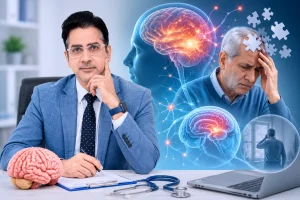
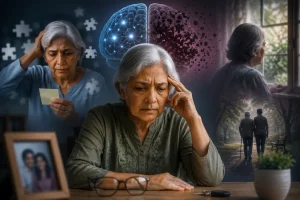
Dementia is one of the most significant neurological challenges of our time. India is estimated to have over 5.3 million people living with dementia, a figure projected to double by 2050 as the population ages. Alzheimer’s disease accounts for 60–70% of all dementia cases, with vascular dementia, Lewy body dementia, and frontotemporal dementia comprising the remainder.
Despite enormous investment in dementia research, disease-modifying treatments remain elusive for most patients. Cholinesterase inhibitors and memantine offer modest symptomatic benefit for Alzheimer’s but do not slow underlying neurodegeneration. This therapeutic gap has intensified interest in non-pharmacological brain stimulation approaches — and rTMS has emerged as the most clinically promising among them.
How rTMS Works in the Dementia Brain
Dementia is characterised by the progressive disruption of large-scale brain networks — the default mode network, the memory encoding circuits of the hippocampus and entorhinal cortex, and the executive networks of the prefrontal cortex. As synaptic connections are lost and neuronal function declines, the brain’s plasticity reserves are depleted.
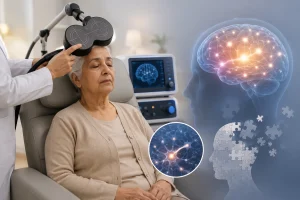
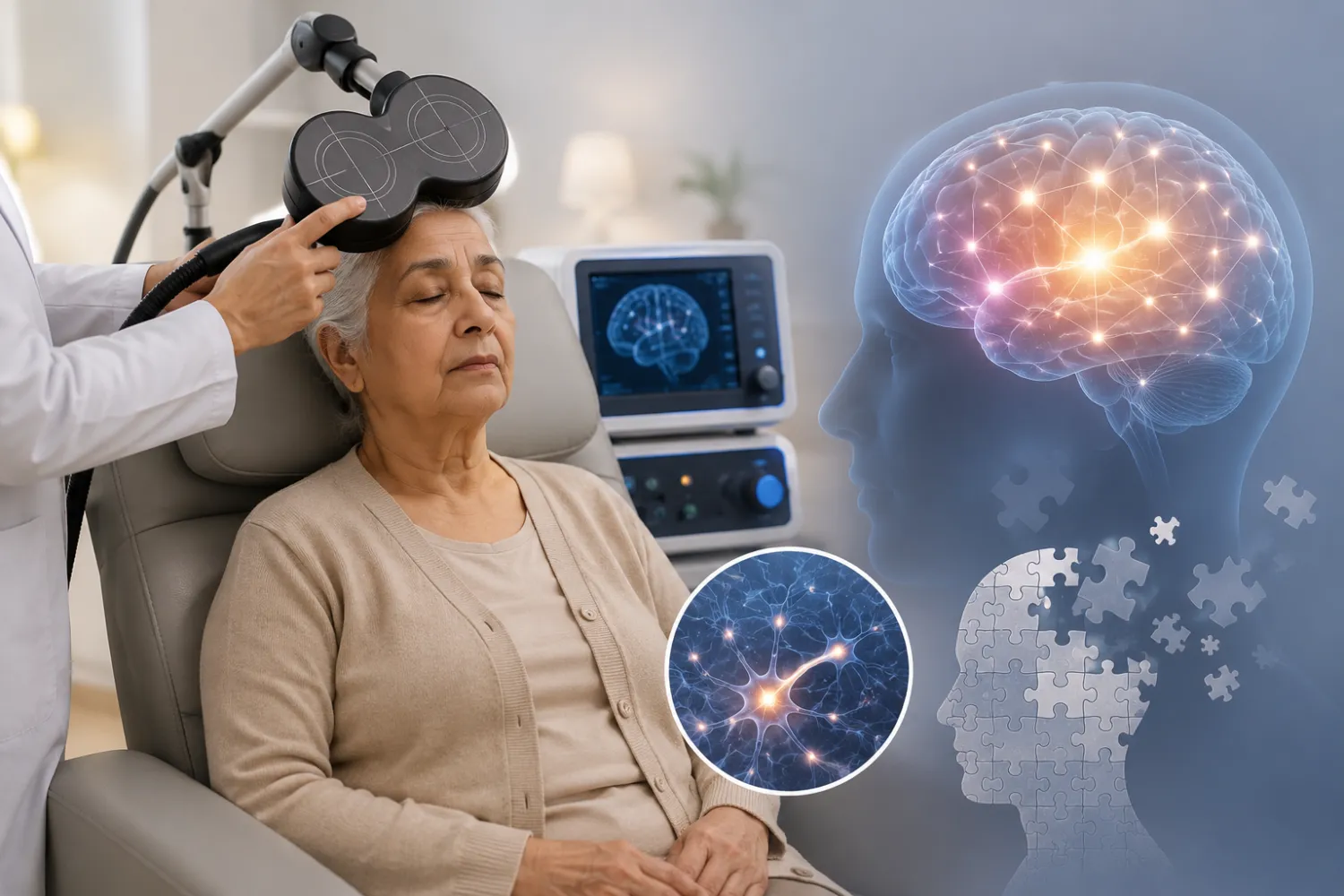
rTMS works by delivering focused magnetic pulses to targeted cortical regions, driving neuronal depolarisation, promoting synaptic strengthening (long-term potentiation), and stimulating neurotrophic factor release — particularly Brain-Derived Neurotrophic Factor (BDNF), which supports neuronal survival and synaptogenesis. In essence, rTMS provides the brain with an exogenous signal that compensates for the loss of endogenous neural drive.
The NeuroAD Protocol: rTMS + Cognitive Training
The most extensively studied rTMS approach for Alzheimer’s disease is the NeuroAD system, which combines high-frequency rTMS with synchronised cognitive training tasks. Six brain regions associated with memory and cognition are stimulated sequentially during each session — the DLPFC (bilateral), Broca’s and Wernicke’s areas (for language), the posterior parietal cortex (for visuospatial function), and the somatosensory association cortex.
The cognitive training tasks are designed to activate each brain region at the moment of stimulation, creating a Hebbian reinforcement (‘neurons that fire together, wire together’) that maximises the therapeutic effect. Clinical trials of the NeuroAD protocol have demonstrated significant improvements in ADAS-Cog scores (the standard measure of Alzheimer’s cognitive performance) and CGIC (clinical global impression of change) compared to sham stimulation, with a respectable safety profile and tolerability.
rTMS Integrated with Standard Dementia Care
At our rTMS treatment centre in Faridabad, rTMS is used as an adjunct to, not a replacement for, evidence-based dementia care:
- Cholinesterase inhibitors (donepezil, rivastigmine, galantamine): These medications enhance cholinergic transmission and may have additive effects when combined with rTMS-induced synaptic plasticity.
- Cognitive rehabilitation: Structured programmes targeting memory, language, executive function, and activities of daily living are scheduled to coincide with rTMS sessions, maximising the window of enhanced plasticity.
- Physical exercise: Aerobic exercise is the most robustly evidenced non-pharmacological intervention for cognitive health, increasing BDNF levels and hippocampal volume. Combined with rTMS, the synergistic neurobiological effect is significant.
- Carer support and psychoeducation: Family education, carer wellbeing support, and dementia care planning are integral components of the programme.
Who Is Appropriate for rTMS in Dementia?
rTMS is most appropriate for patients with mild to moderate Alzheimer’s disease or mild cognitive impairment (MCI) — the window of greatest neuroplastic potential and the period when intervention is most likely to slow disease trajectory. In advanced dementia, the neuroplastic substrate for rTMS benefit is significantly reduced.
Patients with vascular cognitive impairment and mixed Alzheimer’s/vascular dementia may also benefit, particularly when rTMS targeting of preserved networks is guided by neuroimaging.
Frequently Asked Questions (FAQs)
Can rTMS reverse Alzheimer’s disease?
No. rTMS cannot reverse the underlying neurodegeneration of Alzheimer’s. It can improve cognitive function, slow the rate of decline, and enhance quality of life — meaningful benefits for patients and families.
How many rTMS sessions are recommended for dementia?
The NeuroAD protocol involves 30 sessions delivered over 6 weeks (5 days per week). Maintenance courses every 3–6 months are often recommended to sustain cognitive benefits.
At what stage of dementia should rTMS be considered?
rTMS is most effective in mild to moderate Alzheimer’s disease and in mild cognitive impairment. Earlier intervention is associated with greater and more sustained benefit.
Is rTMS safe for elderly patients?
Yes. rTMS has an excellent safety profile in older adults. It requires no anaesthesia, produces no cognitive side effects, and is well tolerated even in patients in their 80s and 90s.
Where can I find rTMS specialists near me for dementia in Faridabad?
Prof. (Dr.) Kunal Bahrani is one of the leading Repetitive Transcranial Magnetic Stimulation doctors in India with expertise in cognitive neurology and dementia management. His clinics at Yatharth Super Speciality Hospitals in Faridabad offer specialised rTMS protocols for cognitive decline.
Book an Appointment with Dr. Kunal Bahrani
India’s leading rTMS specialist | Best rTMS Therapy in Delhi NCR | rTMS Treatment Near You
Yatharth Super Speciality Hospital, Sector 20, Faridabad
Plot No 9, Sector-20, Krishna Nagar, New Industrial Township, Faridabad, Haryana 121007
Timing: Mon-Sat – 10:00 AM to 5:00 PM
Phone: +91 8527841220
Yatharth Super Speciality Hospital, Sector 88, Faridabad
RPS City, Sector 88, Faridabad, Haryana 121014
Timing: Mon-Sat – 10:00 AM to 12:00 PM
Phone: +91 8130048652
Mediclub Clinic
House no 857, Ground Floor, Sector 21C, Faridabad, Haryana 121001
Timing: Mon-Sat – 5:30 PM to 7:30 PM
Phone: +91 8527841220
Email: drkunalbahrani@gmail.com
Article 10
Chronic Pain and rTMS — Retraining the Brain’s Pain Map When Nothing Else Works
Introduction: When Pain Becomes a Disease of the Brain
Chronic pain is one of medicine’s most vexing challenges. Affecting an estimated 20–30% of the Indian adult population, it is a leading cause of disability, loss of productivity, and diminished quality of life. Yet despite this enormous burden, chronic pain remains poorly understood and frequently inadequately treated — managed with analgesics, opioids, and anti-inflammatory drugs that address peripheral symptoms without correcting the central neurological dysfunction that sustains chronic pain.
The critical paradigm shift in modern pain medicine is the recognition that chronic pain is not merely a symptom — it is a disease of the central nervous system. In conditions such as fibromyalgia, complex regional pain syndrome (CRPS), neuropathic pain, and chronic widespread pain, the brain’s pain processing networks are structurally and functionally reorganised, creating a self-perpetuating cycle of pain amplification that is independent of the original injury.
Repetitive Transcranial Magnetic Stimulation (rTMS) is the only treatment modality that directly targets and modulates these central pain networks — making it uniquely positioned as a treatment for the most treatment-resistant chronic pain syndromes.
Central Sensitisation: The Brain’s Pain Amplifier
Central sensitisation is the process by which repeated peripheral pain signals alter the central nervous system, lowering pain thresholds, expanding pain receptive fields, and creating pain responses to stimuli that would not normally be painful (allodynia). The motor cortex, anterior cingulate cortex, thalamus, and descending pain modulatory pathways are all involved in this abnormal amplification.
In fibromyalgia, functional imaging reveals abnormally high activity in pain-processing regions and dramatically reduced activity in the descending inhibitory pathways that normally suppress pain signals. In neuropathic pain, cortical reorganisation creates ‘pain memories’ encoded in the somatosensory cortex that persist long after the original nerve injury has healed. These are brain problems — and they require brain-directed treatments.
How rTMS Treats Chronic Pain
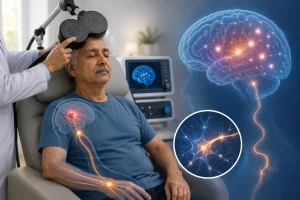
High-frequency (10–20 Hz) rTMS applied to the motor cortex contralateral to the side of pain is the most evidence-supported rTMS protocol for chronic pain. The motor cortex is selected not for its motor function but because of its direct projections to pain-modulatory circuits, including the periaqueductal grey (PAG) — the brain’s principal descending pain inhibitory centre.
rTMS stimulation of the motor cortex activates the PAG and downstream serotonergic and opioidergic systems, increasing the brain’s own endogenous pain-suppression capacity. Simultaneously, it modulates thalamocortical pathways and normalises the dysfunctional cortical representations that characterise chronic pain conditions.
PET imaging studies in chronic pain patients treated with rTMS demonstrate increased blood flow and metabolic activity in the PAG, thalamus, and anterior cingulate cortex — objective evidence of restored descending pain inhibition correlating with significant clinical pain reduction.
Conditions Treated with rTMS at Our Clinic
Our rTMS treatment centre in Faridabad offers motor cortex rTMS for a range of refractory chronic pain conditions:
- Fibromyalgia: Multiple randomised controlled trials demonstrate 30–50% pain reduction with motor cortex rTMS in fibromyalgia, with improvements in fatigue, sleep quality, and global well-being.
- Neuropathic pain: Including diabetic peripheral neuropathy, post-herpetic neuralgia, central post-stroke pain, and phantom limb pain.
- Complex regional pain syndrome (CRPS): rTMS targeting the motor cortex contralateral to the affected limb reduces allodynia and spontaneous pain in CRPS.
- Chronic low back pain: Emerging evidence supports motor cortex rTMS as an adjunct to physiotherapy and pain psychology in chronic low back pain.
- Headache and facial pain: Including trigeminal neuralgia, atypical facial pain, and chronic daily headache.
Integration with Other Pain Interventions
The most effective chronic pain management integrates rTMS within a multi-disciplinary pain programme:
- Nerve blocks: Peripheral nerve blocks, stellate ganglion blocks, and sympathetic blocks address peripheral and regional pain generators, while rTMS simultaneously modulates central processing. The combination addresses both ends of the pain pathway.
- Pain psychology: Acceptance and Commitment Therapy (ACT), mindfulness-based pain management, and pain neuroscience education target the cognitive and emotional dimensions of chronic pain. rTMS enhances the prefrontal modulation that makes psychological pain interventions more effective.
- Low-dose naltrexone (LDN): LDN modulates glial inflammatory activity in the central nervous system, reducing neuroinflammation that drives central sensitisation. Combined with rTMS-induced normalisation of cortical pain networks, the combination shows synergistic promise in fibromyalgia and CRPS.
- Physiotherapy and graded exercise: Carefully structured physical rehabilitation prevents the disuse atrophy and kinesiophobia that perpetuate chronic pain, and is significantly more effective when central pain amplification has been reduced by rTMS.
Frequently Asked Questions (FAQs)
Does rTMS cure chronic pain?
rTMS does not cure the underlying cause of chronic pain. However, it can produce clinically meaningful reductions in pain intensity, improve function and quality of life, and reduce dependence on analgesic and opioid medications in many patients.
How many rTMS sessions are needed for chronic pain?
Initial pain protocols typically involve 10 to 20 sessions. Unlike depression, where benefits may be sustained for months after a single course, chronic pain often benefits from periodic maintenance courses.
Can rTMS reduce opioid dependence in chronic pain?
Yes. Several studies have shown that motor cortex rTMS can produce sufficient pain reduction to allow a meaningful reduction in opioid dosage under medical supervision, reducing side effects and dependence risk.
Is rTMS effective for fibromyalgia?
Yes. rTMS is one of the best-evidenced non-pharmacological treatments for fibromyalgia, with multiple randomised controlled trials demonstrating significant pain reduction, improved sleep, and enhanced well-being.
Where can I find rTMS treatment near me for chronic pain in Delhi NCR?
Prof. (Dr.) Kunal Bahrani, one of the top rTMS specialists in Faridabad and a leading Repetitive Transcranial Magnetic Stimulation doctor in India, offers comprehensive chronic pain rTMS protocols at his clinics in Faridabad. Contact us today for a consultation.
Book an Appointment with Dr. Kunal Bahrani
India’s leading rTMS specialist | Best rTMS Therapy in Delhi NCR | rTMS Treatment Near You
Yatharth Super Speciality Hospital, Sector 20, Faridabad
Plot No 9, Sector-20, Krishna Nagar, New Industrial Township, Faridabad, Haryana 121007
Timing: Mon-Sat – 10:00 AM to 5:00 PM
Phone: +91 8527841220
Yatharth Super Speciality Hospital, Sector 88, Faridabad
RPS City, Sector 88, Faridabad, Haryana 121014
Timing: Mon-Sat – 10:00 AM to 12:00 PM
Phone: +91 8130048652
Mediclub Clinic
House no 857, Ground Floor, Sector 21C, Faridabad, Haryana 121001
Timing: Mon-Sat – 5:30 PM to 7:30 PM
Phone: +91 8527841220
Email: drkunalbahrani@gmail.com