What to Do in the First Hour After a Stroke
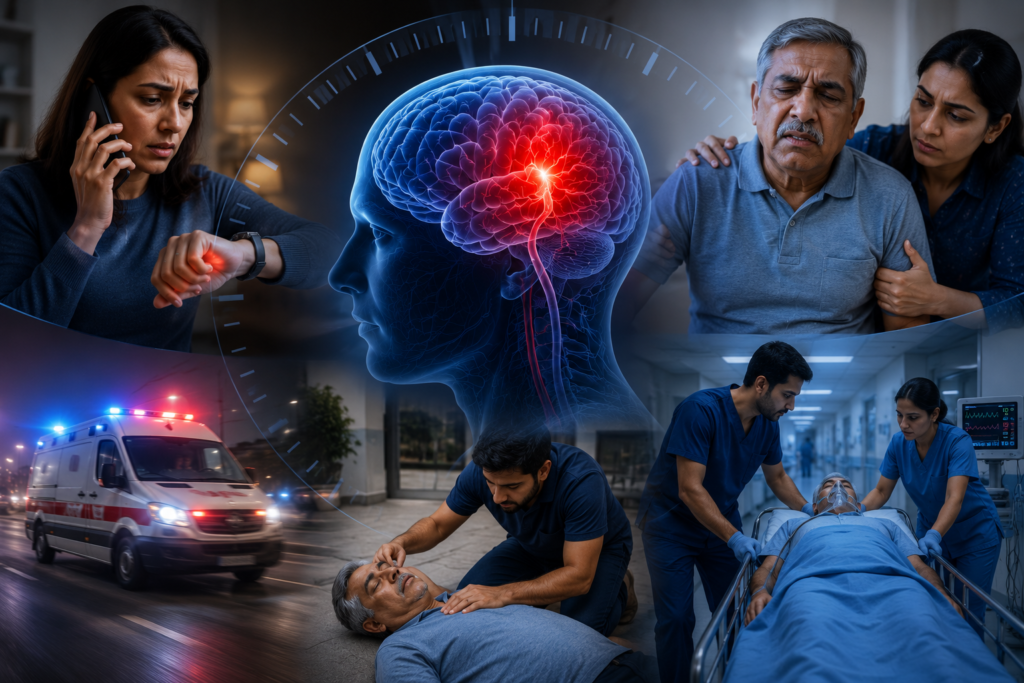
In medicine, there is a concept known as the “golden hour” — the critical window of time after a medical emergency during which prompt treatment dramatically improves survival and recovery outcomes. Nowhere is this more true than in stroke care. The first 60 minutes after a stroke begins can determine whether a patient makes a complete recovery or faces permanent disability.
Dr. (Prof.) Kunal Bahrani, a renowned neurologist in Faridabad, Delhi NCR, has dedicated his career to increasing stroke awareness and improving access to timely care for patients across the Delhi NCR region. This article provides a step-by-step guide to what patients, families, and bystanders should do in that critical first hour after a stroke.
Why the First Hour Is So Critical
During a stroke, approximately 1.9 million neurons (brain cells) die every minute that blood flow is interrupted. Over the course of an average stroke without treatment, the brain ages roughly 3.6 years per hour. This is why neurologists say “time is brain.”
The most effective treatment for ischemic stroke — intravenous thrombolysis with alteplase (tPA, or tissue plasminogen activator) — must be administered within 4.5 hours of symptom onset for maximum effectiveness. Mechanical thrombectomy (a procedure to physically remove the clot) can be performed within 6 to 24 hours in select cases. The earlier treatment is initiated, the greater the chance of meaningful recovery.
Step 1: Recognize the Stroke — Act FAST
The very first step is recognition. Use the FAST acronym: • Face – Is one side drooping? • Arms – Is one arm weak or drifting when raised? • Speech – Is speech slurred or confused? • Time – Note the exact time and call 112 immediately.
Do not wait for symptoms to resolve on their own. Even if symptoms seem mild or improve, the person must still be evaluated by a neurologist immediately, as TIA (transient ischemic attack) symptoms can precede a major stroke within hours.
Step 2: Call Emergency Services Immediately
The moment you suspect a stroke, call 112 (India’s emergency number) without delay. Inform the dispatcher that you suspect a stroke and provide your exact location. This allows emergency responders to alert the receiving hospital so that the stroke team is prepared upon the patient’s arrival — dramatically reducing door-to-treatment time.
Do not attempt to drive the patient to the hospital yourself unless absolutely no other option is available. Ambulance crews are trained to provide initial care and communicate patient status to the hospital en route.
Step 3: Note the Time Symptoms Began
This step is critically important and often overlooked. The exact time that stroke symptoms began — not the time the person was found — determines eligibility for clot-busting treatment. If the person woke up with symptoms, the “last known well” time is when they were last seen without symptoms (e.g., when they went to bed).
Write down or photograph the time immediately. Tell every medical professional you encounter. This single piece of information can determine whether tPA can be administered.
Step 4: Do Not Give Food, Water, or Medications
A stroke can impair the swallowing reflex, making the patient at high risk for aspiration (food or liquid entering the airway). Do not give the person anything to eat or drink — even water. Do not give aspirin or any other medication unless specifically instructed by a medical professional over the phone.
There is a common misconception that giving aspirin during stroke is always helpful. While aspirin is useful in ischemic stroke management, it is contraindicated in hemorrhagic (bleeding) stroke. Since you cannot tell which type of stroke is occurring without a brain scan, it is safest to withhold all medication until the patient is evaluated.
Step 5: Keep the Person Calm and in a Safe Position
Reassure the patient calmly. Panic increases heart rate and blood pressure, which can worsen the situation. Help them lie down comfortably or sit in a safe position. If they are unconscious or vomiting, gently turn them on their side (recovery position) to prevent choking.
Loosen any restrictive clothing around the neck or chest. Do not give the person anything to eat or drink, as mentioned. Keep them warm and monitor their breathing and level of consciousness while waiting for the ambulance.
Step 6: What Happens at the Hospital
When the patient arrives at the emergency department, the stroke team will:
- Perform a rapid clinical assessment (NIHSS — National Institutes of Health Stroke Scale)
- Order a CT scan or MRI of the brain immediately to confirm stroke type and location
- Check blood tests including glucose, clotting profile, and complete blood count
- Monitor blood pressure, oxygen saturation, and cardiac rhythm
If an ischemic stroke is confirmed and the patient is within the treatment window, tPA may be administered intravenously. In cases where a large artery is blocked, the patient may be taken to an angiography suite for mechanical thrombectomy.
For hemorrhagic stroke, management focuses on controlling blood pressure, reversing any blood thinners, and sometimes surgical intervention.
Step 7: Begin Rehabilitation as Early as Possible
Stroke recovery begins within the first 24 hours. Research shows that early mobilization and rehabilitation improve outcomes significantly. Within the first day, physiotherapists and occupational therapists begin assessments. Speech and language therapy begins early for those with communication difficulties.
The brain has a remarkable ability to reorganize itself after injury — a property known as neuroplasticity. Early, intensive rehabilitation harnesses this ability and gives patients the best chance at regaining function.
Conclusion
Acting swiftly and correctly in the first hour after a stroke can mean the difference between full recovery and permanent disability. Every member of a family should know the FAST signs, have emergency numbers saved, and know the nearest stroke-capable hospital. In Faridabad and the Delhi NCR region, Dr. (Prof.) Kunal Bahrani provides expert, compassionate neurological care for stroke patients and their families.
Book Your Appointment with Dr. (Prof.) Kunal Bahrani
Consult Dr. (Prof.) Kunal Bahrani – Leading Neurologist in Faridabad, Delhi NCR
Yatharth Super Speciality Hospital, Sector 20, Faridabad
Plot No 9, Sector-20, Krishna Nagar, New Industrial Township, Faridabad, Haryana 121007
Timing: Mon–Sat | 10:00 AM – 5:00 PM
Phone: +91 8527841220
Yatharth Super Speciality Hospital, Sector 88, Faridabad
RPS City, Sector 88, Faridabad, Haryana 121014
Timing: Mon–Sat | 10:00 AM – 12:00 PM
Phone: +91 8130048652
Mediclub Clinic
House No. 857, Ground Floor, Sector 21C, Faridabad, Haryana 121001
Timing: Mon–Sat | 5:30 PM – 7:30 PM
Phone: +91 8527841220
Email: drkunalbahrani@gmail.com