
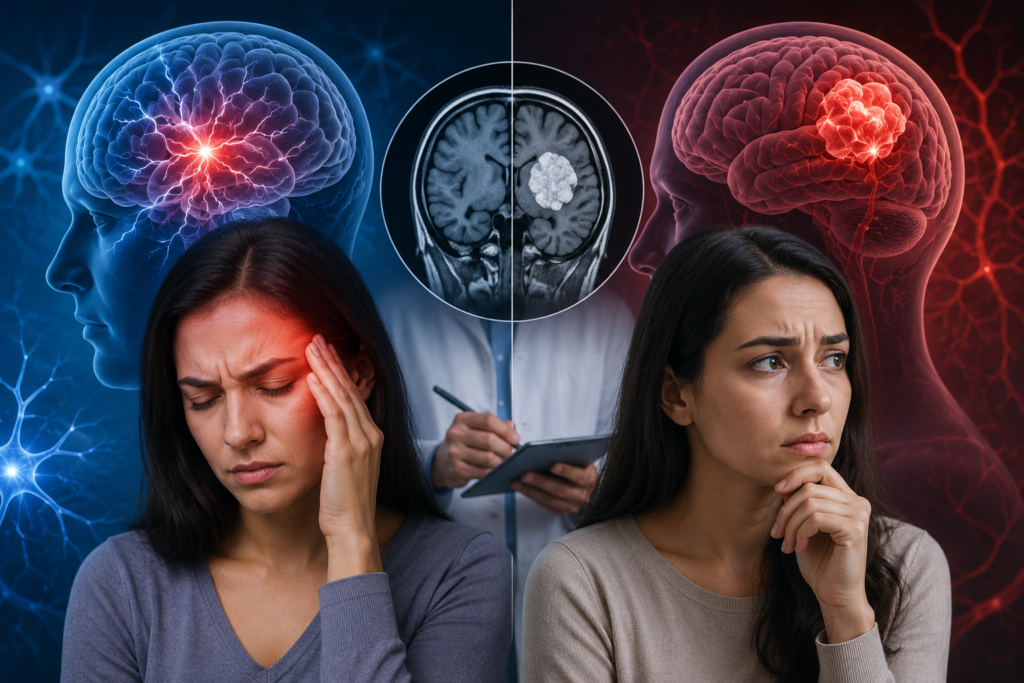
Migraine vs. Brain Tumor: How Doctors Tell the Difference
Headaches are one of the most common neurological complaints, affecting millions of people worldwide. While most headaches are benign — including tension headaches and migraines — some patients understandably worry about more serious causes, such as a brain tumor. Understanding the differences between a migraine and a brain tumor headache is essential for both patients and caregivers. Dr. (Prof.) Kunal Bahrani, a distinguished neurologist in Faridabad, Delhi NCR, has helped countless patients navigate this very concern with expert clinical evaluation and evidence-based care.
What Is a Migraine?
A migraine is a neurological disorder characterized by recurrent, moderate-to-severe headaches, often on one side of the head. The pain is typically throbbing or pulsating in nature and is frequently accompanied by nausea, vomiting, and sensitivity to light and sound. Migraines can last anywhere from 4 to 72 hours and are often preceded by warning signs called an “aura” — visual disturbances, numbness, or speech difficulties.
Migraines tend to have identifiable triggers such as stress, hormonal changes, certain foods, irregular sleep, or bright lights. They are far more common in women and usually begin in adolescence or early adulthood. The good news is that migraines, while debilitating, are not life-threatening.
Headaches Caused by Brain Tumors
Brain tumor-related headaches are far less common but need to be identified promptly. These headaches occur because a growing tumor increases pressure within the skull (intracranial pressure). Unlike migraines, brain tumor headaches tend to worsen progressively over days or weeks and may not respond well to standard pain medications.
Key characteristics that differentiate brain tumor headaches include:
- Pain that is worst in the morning upon waking
- Headaches that worsen with bending, coughing, or straining
- Pain that is steady and dull rather than throbbing
- Associated with neurological symptoms like vision changes, weakness on one side of the body, slurred speech, or seizures
- Accompanied by unexplained nausea and vomiting not related to movement or light
Importantly, not all brain tumors cause headaches in the early stages. Headache as an isolated symptom of a brain tumor is actually quite rare.
How Doctors Differentiate Between the Two
Neurologists like Dr. (Prof.) Kunal Bahrani use a combination of detailed medical history, clinical examination, and diagnostic tools to distinguish between a migraine and a potentially serious brain pathology.
- Medical History: The doctor asks about the onset, duration, frequency, and character of the headache. A family history of migraines, triggers, and associated symptoms are all carefully evaluated.
- Neurological Examination: A thorough clinical examination helps detect any subtle neurological deficits — abnormalities in eye movement, coordination, balance, or strength that might suggest a space-occupying lesion.
- Red Flag Symptoms (“SNOOP” Criteria): Neurologists are trained to watch for warning signs that warrant immediate investigation:
- S – Systemic features (fever, weight loss, cancer history)
- N – Neurological symptoms (weakness, confusion, seizures)
- O – Onset sudden (thunderclap headache, worst headache of life)
- O – Onset after age 50
- P – Progressive headache pattern or postural worsening
- Imaging Studies: An MRI (Magnetic Resonance Imaging) with contrast is the gold standard for ruling out brain tumors, vascular abnormalities, and other structural causes. A CT scan may be used in emergency settings. Most patients presenting with classic migraine features and normal neurological exams do not require imaging unless red flags are present.
- Eye Examination: Papilledema (swelling of the optic disc) found during an eye exam can suggest elevated intracranial pressure, prompting urgent investigation.
When Should You Be Concerned?
You should see a neurologist immediately if: • Your headache is described as “the worst headache of your life” • Headaches are progressively worsening over weeks • You have a new headache pattern after age 50 • Your headache is associated with visual changes, weakness, or confusion • You wake up at night with a headache • Headaches are associated with nausea and vomiting without light/sound sensitivity
On the other hand, if your headaches have been occurring for years, have consistent triggers, and are relieved by standard migraine medications, they are most likely migraines.
The Importance of Expert Evaluation
Self-diagnosis based on internet searches is never advisable when it comes to neurological symptoms. The same symptom — a headache — can have dozens of causes ranging from completely benign to life-threatening. Dr. (Prof.) Kunal Bahrani emphasizes that timely, expert evaluation not only provides peace of mind but ensures that serious conditions, if present, are caught early when treatment is most effective.
If you or a loved one experiences persistent, severe, or unusual headaches in Faridabad or the Delhi NCR region, do not delay seeking specialist care.
Conclusion
While migraines and brain tumor headaches can sometimes share overlapping symptoms, there are clear distinguishing clinical features that a trained neurologist can identify. Most people with recurrent headaches have migraines or tension-type headaches — not tumors. However, headaches with red flag features must never be ignored. Trust a specialist to make the right call.
Book Your Appointment with Dr. (Prof.) Kunal Bahrani
Consult Dr. (Prof.) Kunal Bahrani – Leading Neurologist in Faridabad, Delhi NCR
Yatharth Super Speciality Hospital, Sector 20, Faridabad
Plot No 9, Sector-20, Krishna Nagar, New Industrial Township, Faridabad, Haryana 121007
Timing: Mon–Sat | 10:00 AM – 5:00 PM
Phone: +91 8527841220
Yatharth Super Speciality Hospital, Sector 88, Faridabad
RPS City, Sector 88, Faridabad, Haryana 121014
Timing: Mon–Sat | 10:00 AM – 12:00 PM
Phone: +91 8130048652
Mediclub Clinic
House No. 857, Ground Floor, Sector 21C, Faridabad, Haryana 121001
Timing: Mon–Sat | 5:30 PM – 7:30 PM
Phone: +91 8527841220
Email: drkunalbahrani@gmail.com