rTMS After Stroke — Rewiring the Brain When Time Has Passed
Introduction: Stroke Recovery Is Not a Fixed Destination
Stroke is the second leading cause of death globally and the leading cause of long-term adult disability. Each year in India, nearly 1.8 million people suffer a stroke. For many survivors, the greatest fear is not the acute event — it is the prospect of permanent disability: the arm that will not lift, the words that will not come, the walk that will never return to normal.
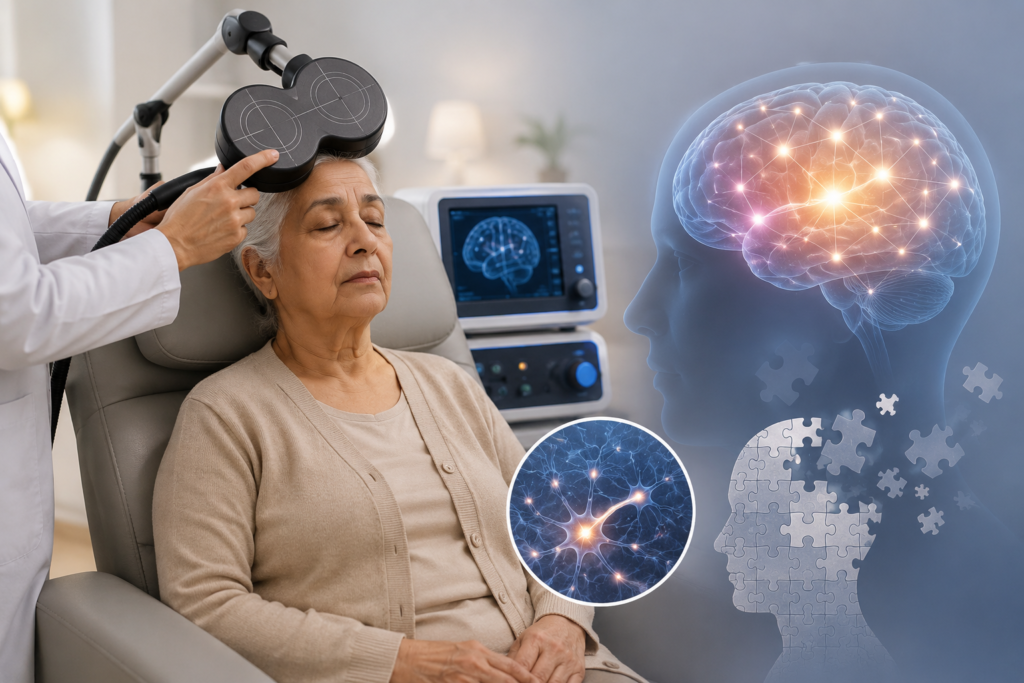
The neurological community has long believed that the most dramatic recovery from stroke occurs in the first three months. While this is largely true, the brain’s capacity for reorganisation — its neuroplasticity — does not switch off after this window. This is where Repetitive Transcranial Magnetic Stimulation (rTMS) offers extraordinary promise, even months or years after the initial stroke.
Understanding Post-Stroke Brain Dynamics
When a stroke damages one hemisphere of the brain, the unaffected hemisphere compensates by increasing its own excitability. Paradoxically, this compensation can impede recovery: the healthy hemisphere suppresses the recovering hemisphere through a process called transcallosal inhibition, preventing the stroke-affected brain regions from reorganising and rebuilding their connections.
rTMS addresses this imbalance with surgical precision. By applying inhibitory, low-frequency rTMS to the unaffected hemisphere (reducing its excessive suppression) or excitatory, high-frequency rTMS to the affected hemisphere (stimulating dormant circuits), clinicians can tip the neuroplastic balance back in favour of recovery.
Motor Recovery: Getting the Arm and Leg Moving Again
Upper limb weakness or paralysis (hemiparesis) following stroke is one of the most disabling sequelae, affecting quality of life, independence, and mental health. Clinical trials have shown that rTMS, when applied over the motor cortex contralateral to the affected limb, significantly improves grip strength, dexterity, and functional arm use compared to physiotherapy alone.
In sub-acute and chronic stroke (beyond three months), rTMS has demonstrated meaningful improvements in arm function even in patients who had plateaued on conventional rehabilitation. The key is timing the stimulation to coincide with active physiotherapy practice — a process called ‘primed rehabilitation’ — which exploits the window of heightened neuroplasticity that rTMS creates.
Speech and Language Recovery: When Words Won’t Come
Post-stroke aphasia — the loss of ability to speak, understand, read, or write — affects approximately 30% of stroke survivors. Recovery from aphasia is notoriously slow and incomplete with speech therapy alone. rTMS offers a compelling adjunct by suppressing the right hemisphere’s interference with left-hemisphere language circuits, freeing the damaged areas to rebuild functional connections.
Studies of patients with chronic non-fluent aphasia have demonstrated significant improvements in naming, sentence production, and conversational fluency following courses of 1 Hz inhibitory rTMS to Broca’s area homologue in the right hemisphere, combined with intensive speech-language therapy.
Integrating rTMS Into a Comprehensive Stroke Rehabilitation Plan
At our rTMS treatment centre in Faridabad, we view rTMS as the neurological catalyst within a broader, multidisciplinary rehabilitation plan that includes:
- Physiotherapy: Active motor training during or immediately after rTMS sessions maximises the plasticity window and accelerates functional gains.
- Occupational therapy: Task-specific training for activities of daily living is integrated with rTMS to translate motor improvements into real-world function.
- Speech and language therapy: Structured aphasia therapy sessions are scheduled to follow rTMS, leveraging the period of enhanced cortical excitability.
- Cognitive rehabilitation: Many stroke survivors experience memory, attention, and executive function impairment. rTMS protocols targeting the DLPFC complement cognitive rehabilitation programmes.
- Psychological support: Depression affects up to 40% of stroke survivors and significantly impairs recovery. rTMS can simultaneously treat post-stroke depression while targeting motor and language recovery.
Who Can Benefit from Post-Stroke rTMS?
rTMS is appropriate for stroke survivors at any stage of recovery who continue to experience motor, speech, or cognitive deficits. While earlier intervention tends to produce larger gains, meaningful improvements have been documented in patients seeking rTMS three or more years after their stroke. Candidates undergo a comprehensive neurological assessment, and MRI imaging is reviewed to guide coil placement and stimulation parameters.
Safety in Stroke Patients
rTMS has an excellent safety profile in stroke populations. It is non-invasive, requires no anaesthesia, and can be administered on an outpatient basis. Patients with cardiac pacemakers or metallic implants near the skull are excluded. The most common adverse effects are mild scalp discomfort and headache, both of which are transient and well-tolerated.
Frequently Asked Questions (FAQs)
Can rTMS help if my stroke was more than a year ago?
Yes. While earlier treatment tends to produce larger gains, rTMS has demonstrated clinically meaningful improvements in patients with chronic stroke, even several years after the event.
How is rTMS different from physiotherapy?
Physiotherapy rebuilds movement through practice. rTMS acts on the brain itself, creating a state of enhanced neuroplasticity that makes physiotherapy more effective. The two treatments work synergistically.
How many sessions will be needed after stroke?
Most stroke rehabilitation protocols involve 10 to 20 rTMS sessions, often delivered daily for 2–4 weeks. This is then combined with intensive physiotherapy or speech therapy.
Where can I find a top rTMS specialist near me in Faridabad?
Prof. (Dr.) Kunal Bahrani is among the top rTMS specialists in Faridabad and one of the most experienced Repetitive Transcranial Magnetic Stimulation doctors in India, offering dedicated stroke rTMS protocols at his clinics in Faridabad.
Is rTMS painful?
No. During rTMS, patients typically feel a tapping or clicking sensation on their scalp. It is well tolerated and does not require any sedation or pain relief.
Book an Appointment with Dr. Kunal Bahrani
India’s leading rTMS specialist | Best rTMS Therapy in Delhi NCR | rTMS Treatment Near You
Yatharth Super Speciality Hospital, Sector 20, Faridabad
Plot No 9, Sector-20, Krishna Nagar, New Industrial Township, Faridabad, Haryana 121007
Timing: Mon-Sat – 10:00 AM to 5:00 PM
Phone: +91 8527841220
Yatharth Super Speciality Hospital, Sector 88, Faridabad
RPS City, Sector 88, Faridabad, Haryana 121014
Timing: Mon-Sat – 10:00 AM to 4:00 PM
Phone: +91 8130048652
Mediclub Clinic
House no 857, Ground Floor, Sector 21C, Faridabad, Haryana 121001
Timing: Mon-Sat – 5:30 PM to 7:30 PM
Phone: +91 8527841220
Email: drkunalbahrani@gmail.com