
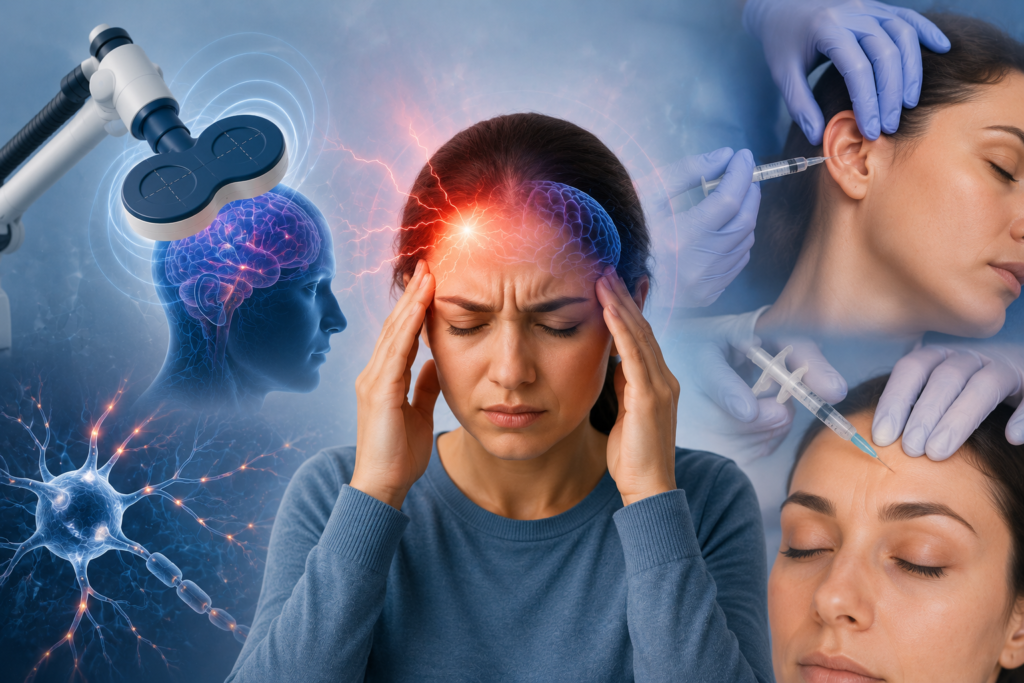
Migraines That Won’t Quit — The Case for Combining rTMS, Nerve Blocks, and Botox
Introduction: When Migraines Take Over Your Life
Migraine is not just a headache. It is a complex neurological disorder that can render sufferers unable to work, care for their families, or engage in everyday life. In India, over 150 million people are affected by migraines, with women disproportionately impacted. For patients with chronic migraine — defined as 15 or more headache days per month — the burden is immense and the treatment landscape frustratingly limited.
As a Repetitive Transcranial Magnetic Stimulation (rTMS) doctor in India, I increasingly see patients who have cycled through multiple preventive medications — topiramate, propranolol, amitriptyline, valproate — without achieving adequate control. For these patients, a combined, multi-modal approach that integrates rTMS with occipital nerve blocks and Botox injections represents the frontier of migraine management.
Understanding Chronic Migraine: A Brain Disorder, Not Just a Headache
Migraine is fundamentally a disorder of neurological excitability. In migraine-prone brains, the cortex is hyperexcitable — it overreacts to sensory stimuli, triggering waves of cortical spreading depression and activating the trigeminal pain pathway. Repeated attacks sensitise central pain pathways, a process called central sensitisation, which is why chronic migraine becomes progressively harder to treat with oral medications alone.
Effective treatment must therefore address multiple points in this cascade: the peripheral trigeminovascular system, the central pain sensitisation mechanisms, and the cortical hyperexcitability that drives attacks. This is precisely what a combined rTMS, nerve block, and Botox approach achieves.
Role of rTMS in Migraine Prevention
Low-frequency (inhibitory) rTMS applied to the occipital cortex and motor cortex reduces cortical hyperexcitability, effectively raising the threshold at which the migraine cascade is triggered. Clinical studies have demonstrated that rTMS can reduce monthly migraine frequency by 40–60% in chronic sufferers.
Single-pulse TMS is already FDA-cleared for acute migraine treatment, while repetitive rTMS protocols target prevention. At our clinic, we use neuronavigation-guided rTMS to precisely target the visual cortex and motor cortex based on each patient’s MRI, optimising individual outcomes.
Occipital Nerve Blocks: Interrupting the Pain at the Source
The greater and lesser occipital nerves transmit pain signals from the back of the scalp to the trigeminal nucleus caudalis — the central relay station of migraine pain. Occipital nerve blocks involve injecting a combination of local anaesthetic and corticosteroid around these nerves, interrupting pain transmission at the peripheral level.
The effect is rapid — many patients experience significant relief within 24–48 hours — and can last 6–12 weeks. When combined with rTMS, which acts centrally to reduce the brain’s overall pain amplification, the combined effect is greater than either treatment alone.
Botulinum Toxin (Botox) for Chronic Migraine
Botulinum toxin type A (Botox) is the only UK-NICE and FDA-approved preventive treatment specifically for chronic migraine. Administered as 31 injections across the head and neck every 12 weeks, Botox works by blocking the release of pain-promoting neuropeptides from peripheral trigeminal nerve endings and reducing central sensitisation over time.
In our experience, the optimal approach for high-frequency chronic migraine patients is a sequenced protocol: Botox injections every 12 weeks providing baseline peripheral blockade, occipital nerve blocks used during breakthrough periods or as an acute intervention, and rTMS sessions — typically 15–20 sessions over 4 weeks — administered between Botox cycles to maintain central desensitisation.
CGRP Inhibitors: The Newest Layer in the Protocol
Calcitonin gene-related peptide (CGRP) inhibitors — including erenumab, fremanezumab, and galcanezumab — represent the most significant advance in migraine prevention in two decades. These monoclonal antibodies block the CGRP pathway, which is the primary driver of migraine neuroinflammation. For patients who do not achieve adequate control with Botox and rTMS alone, adding a CGRP inhibitor creates a comprehensive, multi-mechanistic preventive strategy.
Building the Right Protocol for Each Patient
Not every chronic migraine patient requires all three interventions simultaneously. At our rTMS treatment centre in Faridabad, we assess each patient individually, considering attack frequency, prior treatment responses, comorbidities, and patient preference to design a personalised combination protocol. A typical pathway might begin with rTMS and occipital nerve blocks, escalating to Botox if monthly attacks remain above 8–10 despite initial treatment.
Frequently Asked Questions (FAQs)
How many rTMS sessions are needed for migraines?
A typical preventive course involves 15 to 20 sessions over 3 to 4 weeks. Maintenance sessions may be recommended every 3–6 months.
Can rTMS be used during a migraine attack?
Single-pulse TMS is used acutely during aura. Repetitive rTMS is used for prevention, not during active attacks.
How long does Botox for migraine last?
Each set of Botox injections provides approximately 12 weeks of benefit. Three consecutive treatment cycles (9 months) are recommended before assessing long-term efficacy.
Are nerve blocks painful?
Occipital nerve blocks involve a brief injection discomfort lasting a few seconds. The procedure takes less than 5 minutes in total.
Where can I find the best rTMS therapy in Delhi NCR for migraines?
Prof. (Dr.) Kunal Bahrani offers comprehensive migraine management including rTMS, nerve blocks, and Botox at his clinics in Faridabad. He is widely regarded as one of the top rTMS specialists in Faridabad and among the best rTMS Therapy providers in Delhi NCR.
Book an Appointment with Dr. Kunal Bahrani
India’s leading rTMS specialist | Best rTMS Therapy in Delhi NCR | rTMS Treatment Near You
Yatharth Super Speciality Hospital, Sector 20, Faridabad
Plot No 9, Sector-20, Krishna Nagar, New Industrial Township, Faridabad, Haryana 121007
Timing: Mon-Sat – 10:00 AM to 5:00 PM
Phone: +91 8527841220
Yatharth Super Speciality Hospital, Sector 88, Faridabad
RPS City, Sector 88, Faridabad, Haryana 121014
Timing: Mon-Sat – 10:00 AM to 4:00 PM
Phone: +91 8130048652
Mediclub Clinic
House no 857, Ground Floor, Sector 21C, Faridabad, Haryana 121001
Timing: Mon-Sat – 5:30 PM to 7:30 PM
Phone: +91 8527841220
Email: drkunalbahrani@gmail.com