ADHD and rTMS — A Non-Drug Option for Children and Adults Who Can’t Tolerate Stimulants
Attention Deficit Hyperactivity Disorder (ADHD) is one of the most common neurodevelopmental disorders, affecting an estimated 5–7% of children and 2–5% of adults worldwide. In India, growing awareness has led to increasing diagnosis rates, yet treatment remains challenging. While stimulant medications — methylphenidate and amphetamine salts — are effective for many patients, a significant proportion cannot tolerate them due to side effects including appetite suppression, growth retardation, cardiovascular concerns, sleep disturbance, anxiety, and the stigma associated with controlled substance prescriptions.
ADHD and rTMS — A Non-Drug Option for Children and Adults Who Can’t Tolerate Stimulants — is emerging as a promising alternative approach for individuals seeking safer, non-medication-based treatment options. Dr. Kunal Bahrani is recognized as one of India’s leading rTMS specialists, offering advanced neuromodulation therapies for ADHD and other neurological conditions.
For this population, Repetitive Transcranial Magnetic Stimulation (rTMS) represents a compelling, evidence-informed alternative — one that targets the specific brain circuits underpinning ADHD without systemic drug exposure.
The Neuroscience of ADHD: A Circuit Problem
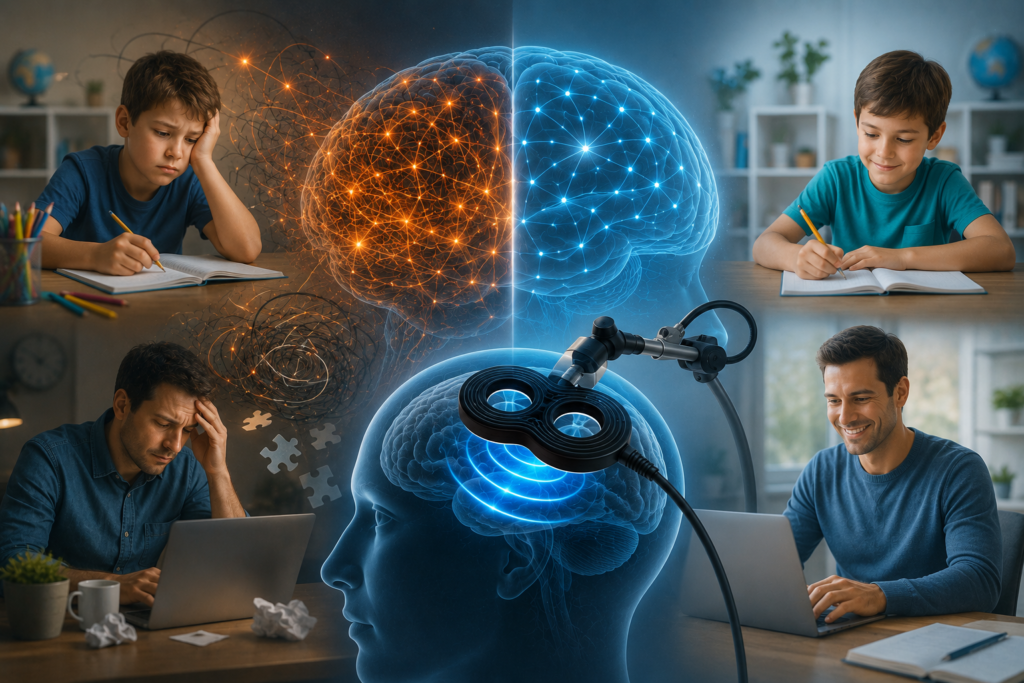
ADHD is fundamentally a disorder of prefrontal-subcortical circuits. The dorsolateral prefrontal cortex (DLPFC) — responsible for working memory, impulse control, planning, and sustained attention — is consistently underactive in ADHD. Neuroimaging studies reveal reduced cortical thickness, diminished grey matter volume, and hypoactivation of the right DLPFC in particular, reflecting deficient top-down control over limbic and subcortical systems.
This is why stimulants work: by increasing dopamine and norepinephrine availability in prefrontal circuits, they temporarily boost the signal-to-noise ratio in the DLPFC, improving attention and inhibitory control. rTMS achieves a similar effect through a fundamentally different mechanism — by directly stimulating the DLPFC with focused magnetic pulses, increasing its intrinsic excitability and improving circuit-level efficiency.
rTMS for ADHD: The Evidence
Research into rTMS for ADHD has grown substantially over the past decade. Studies applying high-frequency rTMS (10–20 Hz) to the right DLPFC have demonstrated significant improvements in:
- Sustained attention and vigilance on neuropsychological testing
- Response inhibition and impulse control
- Working memory capacity
- Hyperactivity ratings on validated ADHD scales (Conners, BRIEF)
- Executive function and organisational ability
A 2021 meta-analysis examining rTMS in ADHD found a moderate-to-large effect size for attention improvement, comparable to behavioural therapy and approaching the effect size of low-to-moderate dose stimulant medication.
rTMS as Part of a Multi-Modal ADHD Management Plan
rTMS does not exist in isolation. At our rTMS treatment centre in Faridabad, it is integrated within a comprehensive management framework:
- Behavioural therapy: Cognitive behavioural approaches, parent training, and school-based interventions remain the cornerstone of ADHD management, particularly in children. rTMS enhances the neuroplastic substrate that makes behavioural learning more effective.
- Neurofeedback: EEG-based neurofeedback trains patients to self-regulate their own brain activity patterns. Combined with rTMS, which directly modulates target circuits, the combination produces more durable improvements than either treatment alone.
- Coaching and executive function training: Structured coaching programmes address the real-world functional impairments of ADHD — time management, task initiation, organisation — and are best delivered during periods of enhanced neuroplasticity created by rTMS.
- Sleep optimisation: Sleep disorders are extraordinarily prevalent in ADHD and significantly worsen core symptoms. Sleep management is addressed as a priority alongside rTMS treatment.
rTMS for ADHD in Children: Safety Considerations
rTMS has been studied in children as young as 7 years of age and has demonstrated a favourable safety profile in paediatric populations when delivered by experienced practitioners using age-appropriate stimulation parameters. The key considerations in paediatric rTMS include: lower stimulation intensities calibrated to the developing brain, shorter session durations, and comprehensive monitoring protocols.
At our clinic, all paediatric rTMS is preceded by a thorough neurological evaluation, parental counselling, and a shared decision-making process that clearly weighs the evidence and alternatives.
ADHD in Adults: A Different Clinical Picture
Adult ADHD often presents differently to childhood ADHD — with predominant inner restlessness, chronic disorganisation, emotional dysregulation, and occupational impairment rather than the overt hyperactivity of childhood. The stigma associated with adult ADHD diagnosis, combined with concerns about stimulant use in middle age (cardiovascular risk, blood pressure, anxiety), makes rTMS a particularly attractive option for this demographic.
Frequently Asked Questions (FAQs)
Is rTMS approved for ADHD?
rTMS is not yet specifically FDA-approved for ADHD (it is approved for depression). However, it is used off-label for ADHD based on a growing evidence base and is offered by specialist centres including ours as part of a comprehensive management plan.
How many rTMS sessions are needed for ADHD?
A standard course involves 20 sessions over 4 weeks. Some patients undergo a longer course of 25–30 sessions, particularly those with more severe executive function impairment.
Can children receive rTMS for ADHD?
Yes, with appropriate safety screening and age-adjusted stimulation parameters. rTMS has been studied in children from age 7 upwards and has a good safety profile when delivered by experienced practitioners.
How does rTMS compare to Ritalin for ADHD?
Stimulant medications typically produce faster and more robust effects on core attention symptoms. rTMS produces more gradual improvement over weeks of treatment but without any systemic side effects and with lasting neuroplastic changes beyond the treatment course.
Where can I find rTMS treatment near me for ADHD in Delhi NCR?
Dr. (Prof.) Kunal Bahrani, a leading Repetitive Transcranial Magnetic Stimulation doctor in India, provides rTMS for ADHD at his clinics in Faridabad. He is recognised as one of the top rTMS specialists in Faridabad with extensive experience in neurodevelopmental conditions.
Book an Appointment with Dr. Kunal Bahrani
India’s leading rTMS specialist | Best rTMS Therapy in Delhi NCR | rTMS Treatment Near You
Yatharth Super Speciality Hospital, Sector 20, Faridabad
Plot No 9, Sector-20, Krishna Nagar, New Industrial Township, Faridabad, Haryana 121007
Timing: Mon-Sat – 10:00 AM to 5:00 PM
Phone: +91 8527841220
Yatharth Super Speciality Hospital, Sector 88, Faridabad
RPS City, Sector 88, Faridabad, Haryana 121014
Timing: Mon-Sat – 10:00 AM to 4:00 PM
Phone: +91 8130048652
Mediclub Clinic
House no 857, Ground Floor, Sector 21C, Faridabad, Haryana 121001
Timing: Mon-Sat – 5:30 PM to 7:30 PM
Phone: +91 8527841220
Email: drkunalbahrani@gmail.com