Beyond Antidepressants — How rTMS Is Reshaping Treatment-Resistant Depression
Depression is one of the most prevalent neurological disorders worldwide, affecting more than 280 million people globally. Yet for nearly one in three patients, traditional antidepressants provide little to no relief. This condition, known as treatment-resistant depression (TRD), leaves patients struggling with failed medications, distressing side effects, and fading hope. Brain Stimulation Treatment such as repetitive Transcranial Magnetic Stimulation (rTMS) is now emerging as a breakthrough, non-invasive solution for patients who have exhausted conventional pharmacological options.
As a Repetitive Transcranial Magnetic Stimulation (rTMS) specialist in India, Dr. (Prof.) Kunal Bahrani has witnessed how advanced rTMS therapy is transforming outcomes and helping patients regain emotional balance, mental wellness, and quality of life. This article explores how rTMS works, who can benefit from it, and why it is increasingly recognised as a gold-standard intervention for treatment-resistant depression.
What Is Treatment-Resistant Depression?
Treatment-resistant depression is defined as depression that does not respond to at least two adequate trials of antidepressant medication. For these patients, every new prescription comes with fresh hope followed by familiar disappointment. The side effects of antidepressants — weight gain, sexual dysfunction, emotional blunting, and sleep disruption — compound the suffering.
The neurobiological reality is this: depression is not simply a serotonin deficiency. It involves dysregulated circuits connecting the prefrontal cortex, the limbic system, and the default mode network. Antidepressants act systemically, affecting receptors throughout the body. rTMS, by contrast, targets the brain directly.
What Is rTMS and How Does It Work?
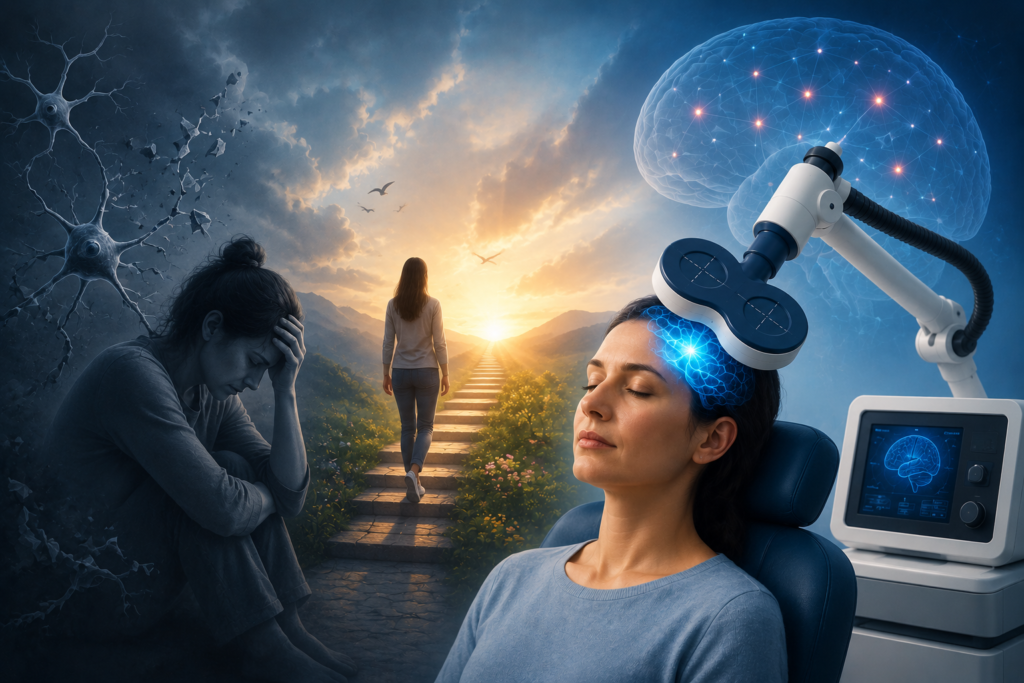
Repetitive Transcranial Magnetic Stimulation (rTMS) is a non-invasive brain stimulation technique approved for depression. A specially designed coil is placed against the scalp and delivers focused magnetic pulses to specific brain regions — most commonly the left dorsolateral prefrontal cortex (DLPFC), which is consistently underactive in depressed patients.
These magnetic pulses generate small electrical currents that depolarise neurons, increasing activity in sluggish circuits and restoring balanced communication across the brain’s mood-regulating networks. Unlike electroconvulsive therapy (ECT), rTMS requires no anaesthesia, produces no seizure, and has no meaningful cognitive side effects. Sessions last 20–40 minutes, and patients remain fully awake and alert throughout.
A standard course of rTMS for depression involves 20 to 30 sessions delivered over 4–6 weeks. The majority of patients begin noticing improvement in sleep, energy, and mood by the second or third week.
The Evidence: What the Research Tells Us
The evidence base for rTMS in depression is robust and growing. Multiple large randomised controlled trials have demonstrated response rates of 50–60% and remission rates of 30–35% in treatment-resistant patients — figures that rival those of pharmacotherapy in treatment-naive patients.
The NeuroStar pivotal trial, the largest multisite study of rTMS for depression, found that patients receiving active rTMS were four times more likely to achieve remission than those receiving sham stimulation. Long-term follow-up studies show that remission can be durable for 12 months or more, especially when combined with maintenance sessions.
rTMS in Combination: A Multi-Modal Approach
At our practice, we do not view rTMS as a standalone cure — we integrate it within a comprehensive, personalised treatment plan. The most powerful results emerge when rTMS is combined with:
- Ketamine infusions: For patients with severe, acute suicidality or melancholic depression, low-dose ketamine can produce rapid antidepressant effects within hours, bridging the patient to the longer-term benefits of rTMS.
- Cognitive Behavioural Therapy (CBT): rTMS enhances neuroplasticity, making the brain more receptive to psychological interventions. Patients undergoing concurrent CBT demonstrate significantly better outcomes than those receiving rTMS alone.
- Pharmacotherapy optimisation: For some patients, rTMS can revive responsiveness to antidepressants that had previously failed, allowing a lower, better-tolerated dose to achieve therapeutic effect.
- Lifestyle medicine: Sleep regulation, exercise protocols, and dietary counselling are structured alongside rTMS to maximise neurobiological benefit.
Who Is an Ideal Candidate for rTMS?
rTMS is suitable for adults with major depressive disorder who have not responded adequately to antidepressant medication. It is also appropriate for patients who cannot tolerate pharmacotherapy due to side effects, those who are pregnant or planning pregnancy, elderly patients sensitive to systemic medications, and individuals with bipolar depression who have not responded to mood stabilisers.
At our rTMS treatment centre in Faridabad, we conduct a thorough neurological evaluation before recommending rTMS, including assessment of depression severity, medication history, and any contraindications such as the presence of metallic implants near the head.
Side Effects and Safety
rTMS is among the safest brain stimulation techniques available. The most common side effect is a mild headache or scalp discomfort at the stimulation site, which typically resolves within minutes of the session and improves as treatment progresses. There is no risk of memory loss, cognitive impairment, or systemic drug interactions.
The rare but serious risk of a seizure occurs in approximately 1 in 10,000 sessions — a figure comparable to the seizure risk associated with many commonly prescribed antidepressants.
Real-World Impact: A Patient Perspective
Many of my patients arrive at the clinic having tried four, five, or even eight different antidepressants over years of suffering. Within three weeks of rTMS, a significant proportion describe something they had almost forgotten — the ability to feel genuine moments of joy, the return of motivation, and the gradual lifting of the fog that depression creates.
One patient, a 44-year-old engineer who had been on antidepressants for seven years without meaningful relief, described his experience after completing a 25-session course of rTMS: ‘I feel like someone has turned the lights back on.’ Stories like his are the reason rTMS has become central to our approach to depression care.
Frequently Asked Questions (FAQs)
How many rTMS sessions are needed for depression?
A typical course involves 20 to 30 sessions over 4 to 6 weeks, delivered on weekdays. Some patients may benefit from an extended course of up to 36 sessions depending on response.
Is rTMS covered by insurance in India?
Coverage varies by insurer and policy. We recommend checking with your insurer directly. Our team can assist with documentation required for pre-authorisation.
Can I continue my antidepressants during rTMS?
Yes. In most cases, rTMS is used alongside existing medication, particularly in the early stages of treatment. Your neurologist will guide any adjustments.
How soon will I feel a difference?
Most patients begin noticing improvement in sleep and energy levels within 2–3 weeks. Mood improvement typically becomes more evident by week 3–4.
Is rTMS available near me in Faridabad or Delhi NCR?
Yes. Dr. Kunal Bahrani, one of the top rTMS specialists in Faridabad and among the leading Repetitive Transcranial Magnetic Stimulation doctors in India, offers rTMS therapy at Yatharth Super Speciality Hospital and Mediclub Clinic in Faridabad.
Book an Appointment with Dr. Kunal Bahrani
India’s leading rTMS specialist | Best rTMS Therapy in Delhi NCR | rTMS Treatment Near You
Yatharth Super Speciality Hospital, Sector 20, Faridabad
Plot No 9, Sector-20, Krishna Nagar, New Industrial Township, Faridabad, Haryana 121007
Timing: Mon-Sat – 10:00 AM to 5:00 PM
Phone: +91 8527841220
Yatharth Super Speciality Hospital, Sector 88, Faridabad
RPS City, Sector 88, Faridabad, Haryana 121014
Timing: Mon-Sat – 10:00 AM to 4:00 PM
Phone: +91 8130048652
Mediclub Clinic
House no 857, Ground Floor, Sector 21C, Faridabad, Haryana 121001
Timing: Mon-Sat – 5:30 PM to 7:30 PM
Phone: +91 8527841220
Email: drkunalbahrani@gmail.com