Parkinson’s Disease and rTMS — Stimulating Hope Beyond Medication
Parkinson’s Disease and rTMS — Stimulating Hope Beyond Medication. Parkinson’s disease (PD) is the world’s fastest-growing neurological disorder, affecting over 10 million people globally, with India accounting for more than 580,000 cases. For decades, levodopa has remained the cornerstone of Parkinson’s management, helping restore near-normal motor function during the early stages of the disease. However, as Parkinson’s progresses, the limitations of medication become increasingly evident, with patients experiencing motor fluctuations, dyskinesias, freezing of gait, and several non-motor symptoms that conventional dopaminergic therapy cannot fully address. This is where repetitive Transcranial Magnetic Stimulation (rTMS) is emerging as a promising, non-invasive treatment option, offering renewed hope beyond medication.
Learn how Dr. (Prof.) Kunal Bahrani, known for advanced neurological care and expert rTMS therapy in Delhi NCR, is helping patients improve their quality of life with cutting-edge brain stimulation treatment.
Repetitive Transcranial Magnetic Stimulation (rTMS) does not replace dopaminergic therapy — it complements it by targeting the neurological circuits that medication alone cannot reach. This article explores how rTMS is being integrated into Parkinson’s care to improve motor function, gait, speech, mood, and cognitive performance.
The Neuroscience of Parkinson’s and Where rTMS Fits
Parkinson’s disease is characterised by the progressive degeneration of dopaminergic neurons in the substantia nigra, disrupting the basal ganglia-thalamo-cortical circuit. The result is abnormal oscillatory activity — particularly in the beta frequency band (13–30 Hz) — that manifests as the signature triad of tremor, rigidity, and bradykinesia.
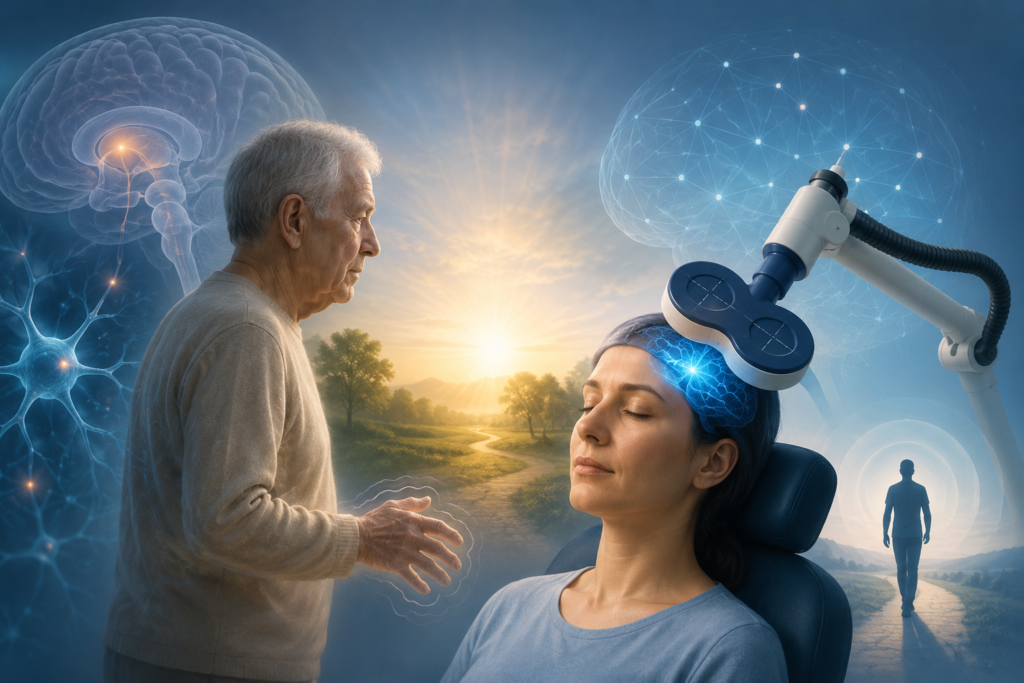
rTMS acts on the cortical end of this circuit, modulating motor cortex excitability and influencing subcortical function through corticospinal projections. High-frequency rTMS (5–20 Hz) over the primary motor cortex or supplementary motor area (SMA) reduces cortical inhibition and enhances the motor system’s responsiveness to dopaminergic signals, effectively amplifying the benefit of existing medication.
rTMS and Motor Symptoms: What the Evidence Shows
Clinical research has documented significant rTMS-related improvements across the core motor features of Parkinson’s disease:
- Tremor: rTMS targeting the cerebellum and motor cortex has shown reduction in resting and action tremor scores, particularly in patients with suboptimal medication control.
- Bradykinesia: High-frequency rTMS to the primary motor cortex improves movement speed and amplitude, measured by the Unified Parkinson’s Disease Rating Scale (UPDRS).
- Freezing of gait: Stimulation of the SMA and pre-motor cortex reduces freezing episodes and improves stride length and gait velocity — one of the most disabling and medication-resistant features of advanced Parkinson’s.
- Dysarthria: Low-frequency rTMS targeting the speech motor cortex has shown benefit in improving vocal loudness and articulation in Parkinson’s patients with hypophonia.
Parkinson’s and Non-Motor Symptoms: rTMS Beyond Movement
Depression affects up to 40% of Parkinson’s patients and significantly worsens quality of life. rTMS targeting the left DLPFC — the same protocol used in treatment-resistant depression — has demonstrated antidepressant effects specifically in the Parkinson’s population, without the cognitive or systemic risks of antidepressant medications.
Cognitive impairment in Parkinson’s, ranging from mild cognitive impairment to Parkinson’s dementia, is another area of active rTMS investigation. Preliminary studies suggest that multi-target rTMS protocols combining DLPFC and parietal stimulation can improve attention, working memory, and executive function in early to moderate Parkinson’s cognitive decline.
Integrating rTMS with Deep Brain Stimulation and Medication
For patients who have undergone deep brain stimulation (DBS) surgery, rTMS can complement DBS effects by targeting cortical circuits that DBS does not directly reach. In our clinical practice, rTMS is safely used in DBS patients with appropriate safety screening, providing additional benefit for axial symptoms (gait and balance) that DBS often does not fully address.
The optimal integration strategy involves synchronising rTMS sessions with the patient’s ‘on’ medication period — the window of peak dopaminergic effect — to maximise the synergistic interaction between enhanced dopaminergic transmission and rTMS-induced cortical modulation.
Gait Rehabilitation with rTMS: A Closer Look
Freezing of gait is one of the most dangerous and humiliating features of Parkinson’s disease, significantly increasing fall risk and reducing independence. Conventional gait rehabilitation — treadmill training, cueing strategies, Nordic walking — provides modest benefit. When rTMS stimulation of the SMA is delivered prior to or during gait training sessions, the combination produces significantly greater improvements in freezing frequency, step length, and gait speed than rehabilitation alone.
Frequently Asked Questions (FAQs)
Can rTMS cure Parkinson’s disease?
No. rTMS does not reverse the underlying neurodegeneration of Parkinson’s disease. It is a symptomatic treatment that improves motor and non-motor function, complements medication, and enhances the quality of life of patients with Parkinson’s.
Is rTMS safe for Parkinson’s patients on levodopa?
Yes. rTMS is compatible with all standard Parkinson’s medications. Your neurologist will advise on the optimal timing of rTMS sessions relative to your medication schedule.
Can Parkinson’s patients with DBS receive rTMS?
DBS does not automatically exclude rTMS, but careful safety screening is required. Patients with DBS should be assessed individually by a specialist with experience in both DBS and rTMS.
How many rTMS sessions are recommended for Parkinson’s?
A typical initial course involves 15 to 20 sessions. Many patients benefit from periodic maintenance courses every 3–6 months to sustain improvements.
Where can I find rTMS specialists near me for Parkinson’s in Faridabad?
Prof. (Dr.) Kunal Bahrani is one of the top rTMS specialists in Faridabad and among the most experienced Repetitive Transcranial Magnetic Stimulation doctors in India for Parkinson’s management. His clinics are located at Faridabad.
Book an Appointment with Dr. Kunal Bahrani
India’s leading rTMS specialist | Best rTMS Therapy in Delhi NCR | rTMS Treatment Near You
Yatharth Super Speciality Hospital, Sector 20, Faridabad
Plot No 9, Sector-20, Krishna Nagar, New Industrial Township, Faridabad, Haryana 121007
Timing: Mon-Sat – 10:00 AM to 5:00 PM
Phone: +91 8527841220
Yatharth Super Speciality Hospital, Sector 88, Faridabad
RPS City, Sector 88, Faridabad, Haryana 121014
Timing: Mon-Sat – 10:00 AM to 4:00 PM
Phone: +91 8130048652
Mediclub Clinic
House no 857, Ground Floor, Sector 21C, Faridabad, Haryana 121001
Timing: Mon-Sat – 5:30 PM to 7:30 PM
Phone: +91 8527841220
Email: drkunalbahrani@gmail.com