Can rTMS Fix Your Sleep? The Science Behind Magnetic Brain Stimulation for Insomnia
Chronic insomnia affects an estimated 30% of the Indian adult population, making it one of the most prevalent and underrecognised neurological complaints encountered in clinical practice. Can rTMS Fix Your Sleep? The Science Behind Magnetic Brain Stimulation for Insomnia explores how emerging neuromodulation therapies are offering new hope for individuals struggling with persistent sleep disorders. Despite insomnia’s enormous burden — impaired cognitive performance, increased risk of depression, cardiovascular disease, metabolic syndrome, and motor accidents — it is frequently dismissed as stress-related or treated with sedative hypnotics that address symptoms without correcting the underlying neurobiology.
Emerging research is revealing that chronic insomnia is, at its core, a disorder of cortical hyperarousal — an inability of the brain to disengage from active, wake-promoting states and transition into the restorative slow-wave sleep that the body and mind require. This is precisely where Repetitive Transcranial Magnetic Stimulation (rTMS) offers a compelling and evidence-informed solution.
The Neuroscience of Sleep and Insomnia
Healthy sleep architecture depends on the brain’s ability to reduce high-frequency gamma and beta activity associated with conscious wakefulness, and increase slow delta oscillations (0.5–4 Hz) that characterise deep, restorative slow-wave sleep. In chronic insomnia, this oscillatory shift is impaired — EEG studies consistently reveal elevated high-frequency cortical activity during sleep in insomnia patients, a phenomenon called ‘cortical hyperarousal.’
The sensorimotor cortex and prefrontal regions play a critical role in regulating the sleep-wake transition. Dysregulation of the default mode network — the brain’s ‘idle’ circuit — prevents insomniacs from mentally ‘switching off,’ sustaining ruminative thinking that perpetuates wakefulness.
How rTMS Promotes Sleep
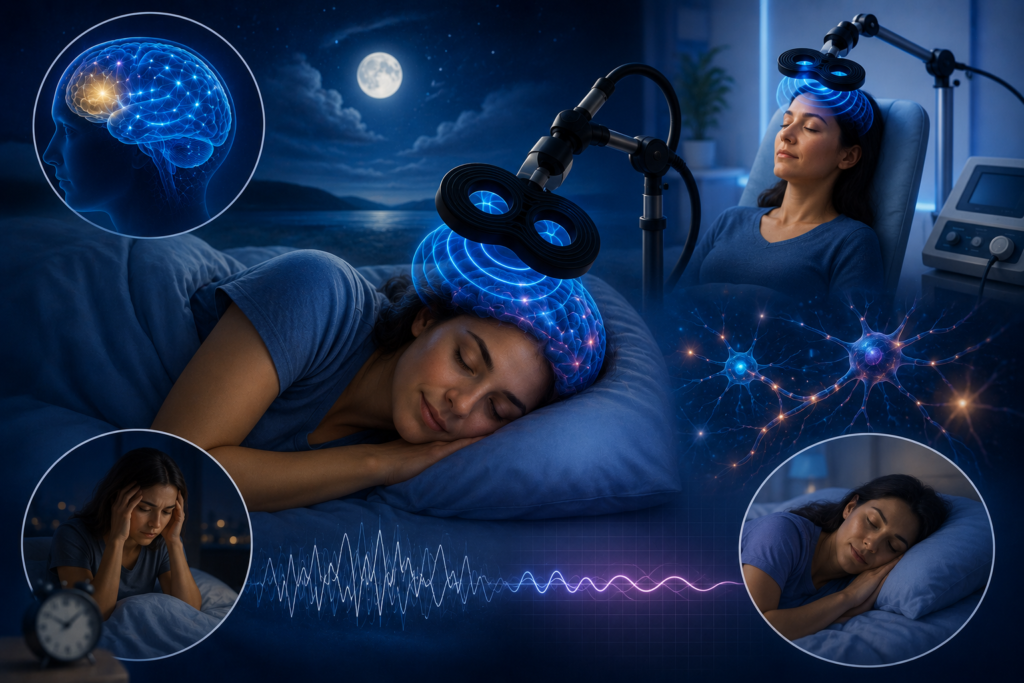
Low-frequency (1 Hz) rTMS applied to the sensorimotor cortex reduces cortical excitability, dampening the high-frequency hyperarousal that characterises insomnia. This downregulation promotes the neurochemical environment necessary for sleep initiation and maintenance.
Concurrently, rTMS targeting the DLPFC reduces the ruminative cognitive hyperactivity that keeps insomniacs awake at night. EEG studies conducted after rTMS treatment in insomnia patients show measurable increases in slow-wave sleep duration and sleep spindle density — objective markers of improved sleep quality that correlate strongly with subjective reports of refreshed waking.
rTMS Combined with CBT-I: The Gold-Standard Combination
Cognitive Behavioural Therapy for Insomnia (CBT-I) is the recommended first-line treatment for chronic insomnia, with superiority over sleep medications in long-term outcomes. However, CBT-I is demanding — it requires consistent implementation of sleep restriction, stimulus control, and cognitive restructuring over 6–8 weeks, and many patients with severe hyperarousal cannot engage sufficiently to benefit early in treatment.
rTMS addresses this barrier: by reducing cortical hyperarousal and improving objective sleep parameters early in the treatment course, it creates the neurobiological conditions that allow patients to engage more effectively with CBT-I. At our rTMS treatment centre in Faridabad, we run rTMS and CBT-I concurrently for the first 3–4 weeks, transitioning to CBT-I maintenance as rTMS treatment concludes.
- CBT-I components: sleep restriction therapy, stimulus control, sleep hygiene education, relaxation training, and cognitive restructuring
- Melatonin: Appropriately timed melatonin (0.5–1 mg taken 5–6 hours before desired sleep time) helps reset circadian phase, particularly in patients with delayed sleep phase disorder
- Sleep hygiene programme: Light management, exercise timing, and dietary modifications are structured alongside rTMS to reinforce healthy circadian rhythms
Who Benefits Most from rTMS for Insomnia?
rTMS is particularly well-suited for patients with chronic insomnia (>3 months duration), those who have not achieved adequate benefit from CBT-I alone or cannot engage with it, patients with comorbid depression or anxiety driving their insomnia, individuals wishing to reduce or discontinue sedative hypnotics, and patients who prefer a non-pharmacological approach.
Safety and Tolerability
rTMS is non-addictive, requires no medication, and produces no morning sedation or cognitive impairment — the primary limitations of hypnotic medications. Sessions are conducted during daytime hours, typically in the morning, which does not interfere with nighttime sleep. The most common side effect is a mild headache that typically resolves within 30 minutes of the session.
Frequently Asked Questions (FAQs)
How quickly does rTMS improve sleep?
Many patients notice improvements in sleep latency (time to fall asleep) and subjective sleep quality within 1–2 weeks of starting rTMS. Objective improvements in sleep architecture typically emerge over 2–4 weeks.
Can rTMS replace sleeping tablets?
rTMS does not replace hypnotics overnight. However, it can create the neurobiological conditions that allow patients to reduce their hypnotic dose gradually over the course of treatment, under medical supervision.
Is rTMS safe if I have both insomnia and depression?
Yes, and the combination is particularly advantageous. The same rTMS protocol can address both conditions simultaneously — targeting the DLPFC for depression and the sensorimotor cortex for sleep.
How many rTMS sessions are needed for insomnia?
Most insomnia protocols involve 15 to 20 sessions over 3 to 4 weeks. A maintenance session every 4–6 weeks is often recommended to sustain improvements.
Where is the best rTMS therapy available in Delhi NCR for insomnia?
Prof. (Dr.) Kunal Bahrani, one of the top rTMS specialists in Faridabad, offers specialised insomnia rTMS protocols at his clinics at Yatharth Super Speciality Hospital and Mediclub Clinic in Faridabad.
Book an Appointment with Dr. Kunal Bahrani
India’s leading rTMS specialist | Best rTMS Therapy in Delhi NCR | rTMS Treatment Near You
Yatharth Super Speciality Hospital, Sector 20, Faridabad
Plot No 9, Sector-20, Krishna Nagar, New Industrial Township, Faridabad, Haryana 121007
Timing: Mon-Sat – 10:00 AM to 5:00 PM
Phone: +91 8527841220
Yatharth Super Speciality Hospital, Sector 88, Faridabad
RPS City, Sector 88, Faridabad, Haryana 121014
Timing: Mon-Sat – 10:00 AM to 4:00 PM
Phone: +91 8130048652
Mediclub Clinic
House no 857, Ground Floor, Sector 21C, Faridabad, Haryana 121001
Timing: Mon-Sat – 5:30 PM to 7:30 PM
Phone: +91 8527841220
Email: drkunalbahrani@gmail.com